
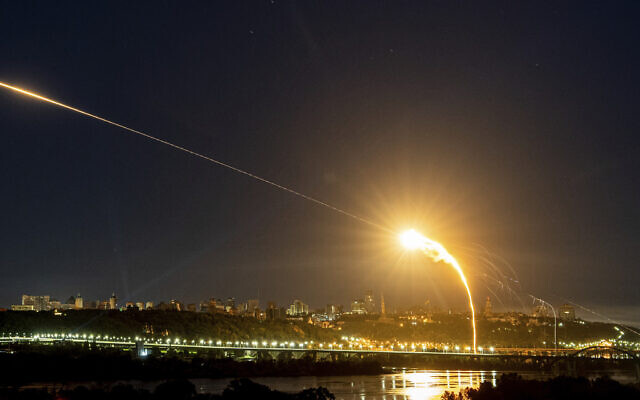
Vladimir Putin has changed his theory of how Russia can win the war in Ukraine. After years of grinding ground offensives that have produced near-zero net advances in recent months, the Kremlin is now banking on a campaign of long-range ballistic missiles and jet-powered drones to force Ukraine to capitulate over the winter of 2026-2027, the Institute for the Study of War says in its September 27 assessment.
Even a prominent Kremlin-affiliated military blogger has embraced the shift, acknowledging that the frontline is "static" and calling on Moscow to intensify and speed up its strike campaign while resources are plentiful. Putin, ISW assesses, may no longer believe Russian forces can advance indefinitely until Ukraine surrenders — Ukraine's 2026 battlefield successes have forced a rethink, replacing the old theory of victory with one built on terror from the sky.
A plan to force capitulation before spring 2027
The new strategy is explicitly time-bound. ISW assesses that Putin does not envision the long-range strike campaign lasting indefinitely; instead, he is attempting to force Ukraine to capitulate before Spring 2027.
The plan rests on a cold calculation. It assumes that Ukrainian air defenses cannot keep pace with cheap jet-powered Geran-type drones arriving at scale and with high penetration rates, that Ukraine will face a shortage of Patriot interceptors to defend against ballistic missiles in the winter of 2026-2027, and that Ukraine's energy and other critical infrastructure will not be able to withstand months of strikes. On September 25, Putin said Ukraine "must feel" Russia's "retaliatory" strikes — a signal that he intends to escalate into winter, as he has done in previous winters.
The Kremlin-affiliated blogger, however, sounded a note of caution rare in Moscow's commentary: relying on the assumption that Russia can sustain its strike campaign indefinitely and simply ratchet up the pressure is dangerous, because the cost of keeping it going could eventually exceed its effects — especially since Ukrainian forces are escalating their own strikes against Russia. Putin, ISW concludes, remains unlikely to compromise his demands or engage in serious ceasefire negotiations until his new theory has run its course.
The weapons — and the race to stop them
Russia began intensifying its use of jet-powered drones in late April 2026. The Kremlin-affiliated blogger claimed that the strikes against Odesa, Mykolaiv, and Kyiv on the night of September 26-27 were launched mostly with jet-powered Geran-5 drones, and that Russia's diverse strike arsenal and Ukraine's air defense shortages let Moscow maintain the current pace of strikes and expand the types of targets it can hit. Russia launched 170 drones against Ukraine that night, according to ISW.
Ukraine is racing to blunt the campaign. President Volodymyr Zelenskyy said on September 26 that Ukraine's interception rate for jet-powered Shahed drones has reached 55 percent — air defenses intercepted more than 1,500 of the 2,730 such drones Russia launched in September alone. Kyrylo Budanov, head of Ukraine's presidential office, said on September 27 that Ukraine is testing prototypes of interceptor drones in combat conditions and that their mass use against jet-powered Gerans could begin within a few months. Ukrainian companies have already successfully field-tested several interceptor designs.
Kyiv is not only playing defense. Ukraine's strikes against Russian oil infrastructure continue to restrain Russia's oil processing capacity: on September 26, the head of Ukraine's Center for Countering Disinformation reported that Ukrainian strikes had forced both the Perm and Novoshakhtynsk oil refineries to cease operations. Satellite imagery published on September 27 showed Ukrainian strikes had damaged at least five production shops across six buildings — including the foundry, optics, and assembly lines — at the Azov Optical-Mechanical Plant in Azov, Rostov Oblast, some 200 kilometers from the frontline.
Pressure beyond the frontline
Moscow is also normalizing its provocations against Europe. Romania's defense ministry reported that an unidentified aerial object, likely a Russian drone, entered Romanian airspace near Chilia Veche on the night of September 26-27, flying parallel to the Chilia branch of the Danube Delta before the signal was lost near Pardina. Two Spanish F-18 fighter jets and a Romanian IAR-330 helicopter scrambled to monitor it. Romanian authorities have not publicly attributed the incursion to Russia, but ISW notes it fits the Kremlin's pattern of normalizing European airspace violations.
European security services are also investigating suspected Russian sabotage against defense and logistics infrastructure. German newswire FAZ reported on September 25 that German investigators suspect Russia's GRU used incendiary devices to attack the Munich headquarters of technology and defense firms Rohde & Schwarz and Helsing — which supplies the Ukrainian military — on September 3, and that the GRU's suspected head of sabotage operations, Denis Smolyaninov, is likely responsible for the attack on Leipzig Airport on August 5. Danish police are separately investigating an attempted arson attack on a plane wing at Lolland-Falster Airport.
The human cost of the occupation is deepening too. Ukraine's foreign minister reported on September 25 that residents of occupied Oleshky in Kherson Oblast have no food and must eat grass and weeds, after Russian occupation authorities stopped delivering supplies in late December 2025 and abandoned the town entirely in spring 2026. Ukraine has been delivering food there since March, most recently dropping 4,000 kilograms of provisions by drone to 100 locations — only for Russian forces to shoot the drones down, apparently to steal the food for their own troops. The Kremlin, ISW writes, has shown no interest in a local humanitarian ceasefire.
Conclusion
Putin's winter gamble reveals both confidence and desperation: confidence that missiles and drones can succeed where four and a half years of ground war have stalled, and desperation enough to abandon the old theory of victory entirely. But the gamble has a deadline. If Ukraine's air defenses hold — and its interceptor program scales in time — Moscow will enter spring 2027 with the same choice it is trying to dodge today: a costly second mobilization that its own officials have been quietly preparing for even as Putin denies it.
For Kyiv's allies, the message is blunt. The time to harden Ukraine's skies is now, before the winter the Kremlin is counting on.